The Candid Microphone
The Idea That Changed Everything
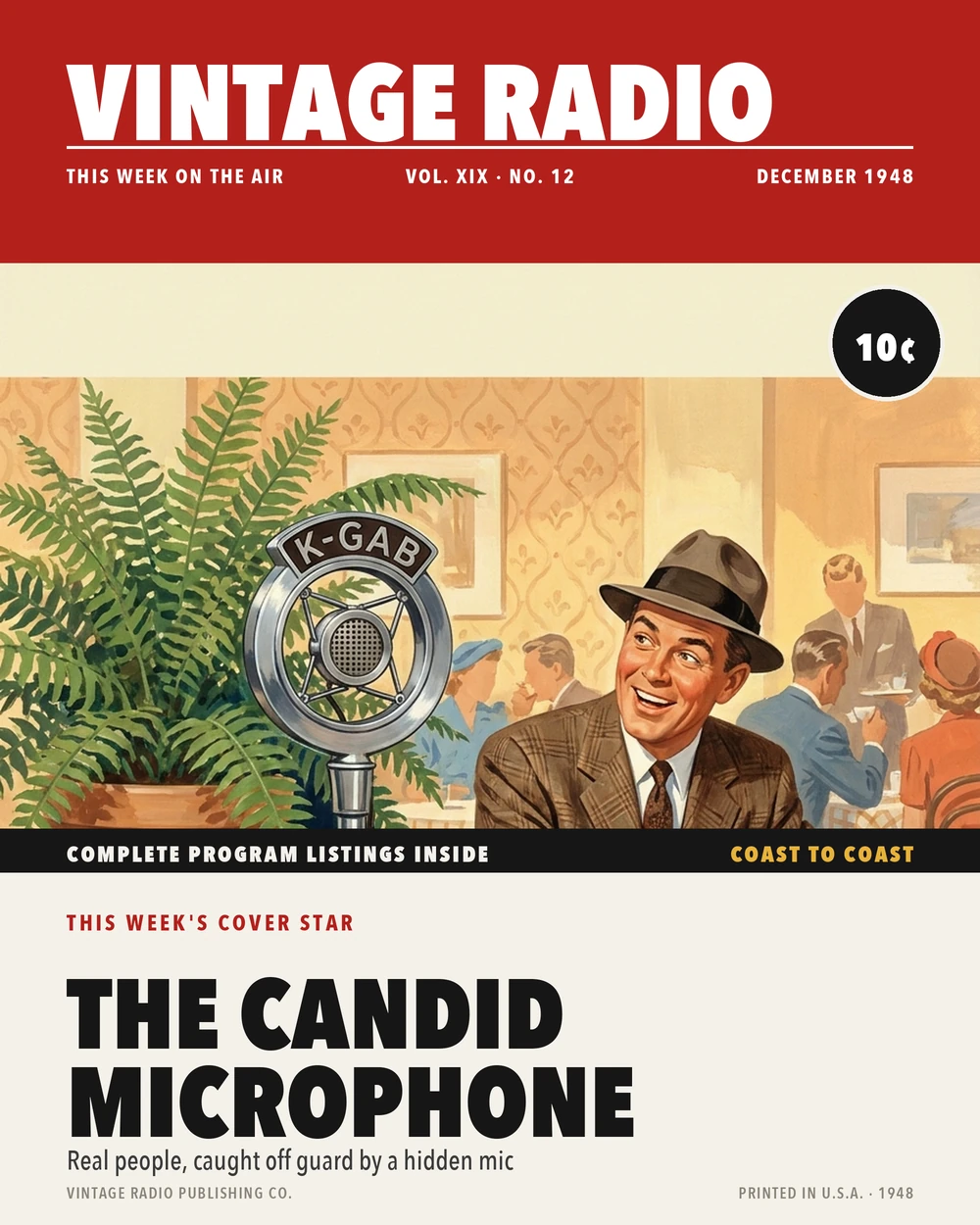
Allen Funt didn't invent The Candid Microphone in a writer's room. The insight came to him at Camp Gruber, Oklahoma, during World War II, where his job was producing radio shows for Armed Forces Radio. He set up what he called "The Gripe Booth" — a place where soldiers could record their complaints for broadcast. But whenever the recording light came on, the soldiers froze up, turned stiff, and said nothing useful. Funt's fix was simple and, in retrospect, obvious: he disconnected the light and started recording during what appeared to be a casual pre-interview warm-up. The moment the men thought no one was listening, they became themselves again.
That was the key. People perform in front of microphones. Remove the microphone — or seem to — and you get something real. Funt filed the idea away, finished his service in the Army Signal Corps, and after his discharge rented an office to figure out how to build a radio show around it. He came out of the service with roughly $300 and fourteen ideas, by his own account. One of those ideas became The Candid Microphone, which premiered on ABC on June 28, 1947.
How the Show Actually Worked
Funt's office was no ordinary workspace. He set it up on the 15th floor of a building across from Grand Central Station — deliberately outside the radio district, so that whoever wandered in wouldn't suspect they were walking into a stunt. At least fifteen concealed microphones were built into the room. When a subject arrived, Funt pressed a button, and an engineer in an adjacent room began capturing everything. The smallest available wire recorder at the time consisted of two pieces of equipment weighing more than 100 pounds combined, so the adjacent room full of sensitive gear was a necessity, not a luxury.
The range of material expanded considerably when a portable recorder finally came to market — still a hefty 27 pounds, but concealable in something resembling a travel bag. The microphone could be disguised as a hearing aid or hidden inside a phony arm cast. With that equipment, Funt's team could work anywhere. He walked into a candy store and asked a saleswoman to "squish" the chocolates so he could tell the soft ones from the nuts. He posed as a shoe salesman and "lost" one of the shoes a customer had worn into the store. He had an engineer hide behind a tree to record his attempts to chat up strangers on a park bench.
The production behind even a single bit was exhausting. For every show built around roughly half a dozen stunts, Funt's team made and discarded at least sixty recordings. He and five assistants worked fourteen to sixteen hours a day. Editing a single three-minute piece of wire could require as many as one hundred splices. When a recording contained language that couldn't air, Funt inserted a soft female voice cooing "censored-censored-censored" over the offending portion. Once a stunt was edited down to its usable form, the wire recording was transferred to a disk for broadcast.
One early lesson shaped everything that followed. Funt's first subject was a sign painter named Lester Cannon, who came to paint the name on Funt's office door. Funt told him the name he wanted painted was "Lester Cannon." The painter balked — and eventually agreed only after negotiating the spelling to "Kannon." From that encounter Funt learned that eavesdropping on ordinary conversation yielded little. What produced interesting recordings was putting a conventional person in an unconventional situation. Scholar Jacob Smith later characterized this as Funt's core innovation: "the rile." Not recording people as they were, but provoking them into reactions that had shape and drama.
Funt used "Lester Kannon" as a working alias in the show's early days. Another early bit involved calling a locksmith to his office, where a secretary appeared to be chained to her desk. Funt told the locksmith he'd lost the key and wanted her unlocked for lunch — and when the locksmith grew indignant, Funt explained that she was a clock-watcher who never got anything done unless shackled. The locksmith's warning — "You better not get caught doing this" — and Funt's reply — "That's my business" — made exactly the kind of radio the show was built for.
What the Critics Made of It
Response to The Candid Microphone was not uniformly enthusiastic, at least at first. Variety reviewed the premiere and called the premise an "amusing idea," but found that "after the novelty wore off early in the show, thin substance began to show through and turned the session into a long half-hour," and suggested the program might be better suited to a fifteen-minute format. The New York Times described it as "what amounts to a huge practical joke."
The show also ran into a persistent credibility problem: listeners refused to believe the stunts were unscripted. Reporter Jerome Beatty, who wrote one of the first substantial profiles of Funt — calling him "the nerviest man in radio" who would ask anybody to do anything in a deadpan manner — compared the show's situation to Information, Please and The Quiz Kids, both of which had faced the same skepticism early on. Audiences were convinced the wits were too witty and the stunts too convenient for any of it to be real.
Other critics were more generous. Media critic John Crosby called listening to The Candid Microphone "a wonderful sport, like looking through keyholes but capable of infinitely greater variety," and concluded: "We are at the beginning of the Age of the Involuntary Amateur … The possibilities are limitless; the prospect is horrifying." Glenn Kittler, writing in the Norfolk Virginian-Pilot, called it "the most original show in a decade," and noted that doctors had praised it as a contribution to the study of psychiatry, while college professors had requested recordings for use in speech courses. Radio Life described Funt as "a great actor" with a "Joe Blow personality" who could sell almost any ridiculous premise, capable of making people believe he was "a bootblack one day or a dentist the next."
In May 1948, the Radio-Television Critics Circle of New York included The Candid Microphone in its first commendation list, recognizing it as one of two shows for "outstanding program developments." Sociologist David Riesman, in his book The Lonely Crowd, called Funt "the second most ingenious sociologist in America."
The Man Behind the Microphone
Allen Funt was born on September 16, 1914, in New York City. He graduated from New Utrecht High School in Brooklyn at fifteen — too young to go directly to college — then studied at the Pratt Institute, went on to earn a bachelor's degree in fine arts from Cornell in 1934, studied business administration at Columbia, and returned to Pratt for more art instruction. He wound up in the radio department of an advertising agency, writing copy and developing stunt ideas. He wrote for Eleanor Roosevelt's Sweetheart Soap chat show in 1940–41 and developed gimmicks for Truth or Consequences. Before the Army, he created a show called Funny Money Man — based loosely on the scavenger hunt concept, with scripts sold to individual stations where local personalities handled the emcee duties — which he described as "the stupidest show in radio," even as it earned him $1,200 a week at its peak.
The behavioral side of his work had real roots. Before the war, Funt had assisted Cornell psychologist Kurt Lewin in experiments on the behavior of mothers and children, and he drew on that background in designing The Candid Microphone's stunts. He always described his project as a study of human nature rather than a practical joke operation. In 1985 he told Psychology Today that when he moved from radio to television it was because he "wanted to go beyond what people merely said, to record what they did — their gestures, facial expressions, confusions and delights."
His subjects usually proved to be good sports. After a stunt was over, Funt revealed it by saying, "You're on Candid Microphone," and offered subjects fifteen dollars, the option of anonymity, and the thrill of being on the air. Permission was rarely denied.
From Radio to Everything Else
The Candid Microphone ran on ABC from its June 1947 premiere through September 1948, bouncing around the schedule — Saturdays, then Sundays, then Mondays, then Thursdays — before the television version arrived on ABC-TV on August 10, 1948, the same day WJZ-TV in New York launched. Trade publication Billboard reported that ABC "completely overhauled the apparatus" on the show to adapt it for television, revising it "to take full advantage of their current visual asset" rather than producing "mere simultaneous duplication."
The radio show returned on CBS from June 6 to August 29, 1950, airing Tuesday nights at 9:30 with Philip Morris as sponsor. When the television version moved to NBC in the fall of 1949, the title changed from Candid Microphone to Candid Camera — and under that name the concept ran on various networks for more than twenty years, with its longest uninterrupted prime-time stretch on CBS Sunday evenings from 1960 to 1967.
Columbia Pictures produced a series of one-reel short films based on the radio program, with the first theatrical release on October 5, 1948. All 29 entries were directed by George Blake, with Ben Blake and George Blake producing; the shorts were reissued through 1956 and again in the 1960s. In 1955, Jubilee Records released The Best of Allen Funt's Candid Mike, a long-playing album of radio excerpts; a Billboard reviewer noted that "the hidden mike gimmick is a good party item, and the off-guard sequences on this disk have their funny moments, altho scarcely in the 'best' category." Funt also wrote three books drawing on the material, including Eavesdropper at Large (Vanguard Press, 1952) and his 1994 memoir Candidly, Allen Funt: A Million Smiles Later.
On February 3, 1969, Funt was a passenger on Eastern Airlines Flight 7 when it was hijacked to Cuba. Fellow passengers recognized him and assumed the whole thing was a Candid Camera stunt — and laughed, leaving the hijackers thoroughly confused. Funt suffered a stroke in 1993 and died on September 5, 1999, in Pebble Beach, California, eleven days before his 85th birthday. A documentary, Mister Candid Camera, was released in 2021. His son Peter had joined him as co-host of Candid Camera specials beginning in 1987, and after Allen's stroke took over as sole host and producer of the franchise.